Showing posts with label Research. Show all posts
Showing posts with label Research. Show all posts
Wednesday, 1 February 2017

Saul Bass Questionnaire & Responses:

Saul Bass Questionnaire and responses:
we asked four different people varying in age, whether or not they have heard of Saul Bass and if they could tell the genre of the film based on the title sequence. The reason for this was to decide whether or not having a title sequence of this style would be effective. We also got feedback of what people thought this title sequence was lacking. Therefore, helping us to decided what other qualities and aspects we could include as well.


Wednesday, 25 January 2017
Order of credits:
Order of Credits in Catch me if you can:
- Dreamworks presents
- Main Star
- Main star
- Title
- Another Star
- Secondary Actors
- Casting
- Co-Producer
- Music Producer
- Costume Designer
- Film Editor
- Director of Photography
- Executive Producer
- Screenplay
- Director
Tuesday, 24 January 2017
Titles and Typography:
What do the typography, design and the way in which the titles appear in catch me if you can communicate to the audience/consider connotations of the films:
-Genre
-Style/Mood
-Possible narratives
-Production values
-Themes
 The title sequence of catch me if you can was influenced by Saul Bass. Through the title sequence it tells the whole narrative of the film in an animation form. The typography helped to indicate who the characters were as it would appear in sync with those certain characters. It also interacted within the scene. This helped to tell part of the narrative and created a sense of movement due to the placing of the typography and the different camera movements such as tracking up and down. A sense of different settings are created, there are many links to travel, initially starting at an airport, then a car journey. the character then takes us to a luxury holiday accommodation. There is an orchestral soundtrack which helps to build tension and suspicion.
i think the typography in this Title sequence is well placed and it helps to guide the audiences eye as to where they should be looking. The way in which the texts moves within the animation and how connects to the scene gives it a real purpose as well as informing the audience. The order in which the titles come up is relevant because it gains the audiences attention and keeps them engaged throughout. It also shows the importance of the stars and who has the most star power.
-Genre
-Style/Mood
-Possible narratives
-Production values
-Themes
The title sequence of catch me if you can was influenced by Saul Bass. Through the title sequence it tells the whole narrative of the film in an animation form. The typography helped to indicate who the characters were as it would appear in sync with those certain characters. It also interacted within the scene. This helped to tell part of the narrative and created a sense of movement due to the placing of the typography and the different camera movements such as tracking up and down. A sense of different settings are created, there are many links to travel, initially starting at an airport, then a car journey. the character then takes us to a luxury holiday accommodation. There is an orchestral soundtrack which helps to build tension and suspicion.i think the typography in this Title sequence is well placed and it helps to guide the audiences eye as to where they should be looking. The way in which the texts moves within the animation and how connects to the scene gives it a real purpose as well as informing the audience. The order in which the titles come up is relevant because it gains the audiences attention and keeps them engaged throughout. It also shows the importance of the stars and who has the most star power.
Saturday, 21 January 2017
Analysis of title sequences in my genre:
Our Genre is Drama/Thriller. the conventions of a Thriller are to create suspense and fear. These films capture this well.
David Finches – Seven (1995)
David Finches – Seven (1995)
 Filmed entirely on 35 mm film. David Finches Seven is a very
good example of a title sequence. Created mainly through close ups of flicking
through a book that was written from the psychopaths point of view. It helps to
give an insight into the type of character without actually providing any shots
revealing the character’s identity except from shots involving the hands
allowing us to associate him as a male character. The use of the book and
flicking through pages creates quite a graphic effect as the character cuts and
sticks in explicit and disturbing imagery. The handmade aspect of it shows the
character to be quite precise and have a clear view in what he wants to achieve
which could link into the obscure but meticulous way in which he kills. The
soundtrack is parallel.
Filmed entirely on 35 mm film. David Finches Seven is a very
good example of a title sequence. Created mainly through close ups of flicking
through a book that was written from the psychopaths point of view. It helps to
give an insight into the type of character without actually providing any shots
revealing the character’s identity except from shots involving the hands
allowing us to associate him as a male character. The use of the book and
flicking through pages creates quite a graphic effect as the character cuts and
sticks in explicit and disturbing imagery. The handmade aspect of it shows the
character to be quite precise and have a clear view in what he wants to achieve
which could link into the obscure but meticulous way in which he kills. The
soundtrack is parallel.
American Psycho (2000)
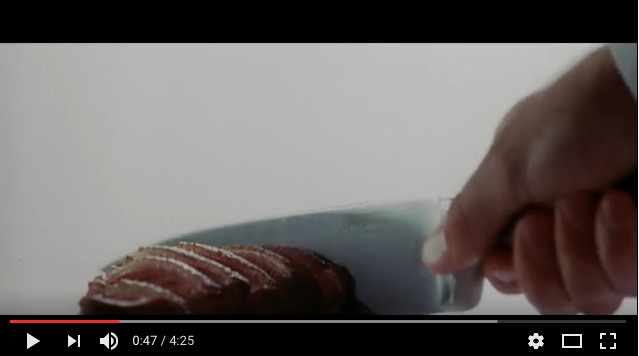 The American psycho title sequence starts of very visual and
subtle and then ends up leading onto the actual start of the film. The use of
food is very unique. It creates narrative enigma because at first it appears
that it Is blood dripping but really it is red sauce going onto a plate of
food. The soundtrack is parallel and in time to when the red sauce is dripping.
It helps to create a daunting atmosphere. The cutting of meat with a knife
could foreshadow the style of murders and indicates towards the narrative.
The American psycho title sequence starts of very visual and
subtle and then ends up leading onto the actual start of the film. The use of
food is very unique. It creates narrative enigma because at first it appears
that it Is blood dripping but really it is red sauce going onto a plate of
food. The soundtrack is parallel and in time to when the red sauce is dripping.
It helps to create a daunting atmosphere. The cutting of meat with a knife
could foreshadow the style of murders and indicates towards the narrative.
Dexter:
 Despite this being the Title sequence for a Television series. It is still relevant to the creation of our title sequence. The title sequence for this shows the main character, Dexter's, morning routine. However all of his actions are made in quite a suggestive way. What is meant by this is that the way I which it has been shot by using close angles implies that there is something quite twisted about this character. An example of this is the first shot which is a close up shot of a mosquito about to bite him, this is followed by him slapping and killing the mosquito. this foreshadows him being a murderer. the Typography is significant because when the Title of the show is shown a blood splatter appears next to the text and the redness of the text darkens almost as though blood is spreading across it. The way in which food is incorporated is similar to American Psycho. However it creates a more uncomfortable viewing. The explicit foley sounds emphasising his every action along with the intense
soundtrack add to the implications that there is an underlying characteristic
of Dexter.
Friday, 20 January 2017
Analysis of Title sequences:
The incredible Hulk 2008;
 The title sequence for the incredible Hulk was so effective because of the creative devices that were used. The first shot is of a red button flashing danger. This immediately engages the audience. There were shots of newspapers and documents claimed as classified. This made the audience intrigued as to what the documents were about. It also showed the evolution of the hulks DNA and blood cells but in a very abstract way showing the chemical reaction taking place. This was visually pleasing to watch but also informative of the adaptations of the character. As well as this, it showed the scientific aspect of the film and suggested The Hulk was the result of an experiment. There is a point of view shot from The Hulks perspective of him gazing at a female scientist who is behind the glass. This indicates towards a romantic subplot that will be explored within the film. A close up shot of the x rays of his brain and body creates narrative enigma. The colour green is included throughout the title sequence which is effective because it is key iconography as that colour is largely associated with the Hulk. In addition to this there is a fast paced soundtrack flowing through the Title sequence which helps to build tension for the audience. A voiceover is also included to give a description of what has taken place.
 Love actually:
The title sequence is very unconventional because it doesn’t incorporate any of the characters into it. However, using archive footage and through a variety of shots it shows different couples reuniting in Heathrow airport.. The types of shots that are included are two shots and long shots. This explores the importance of relationships and human connection. There is a subtle nostalgic soundtrack along with a voiceover using the voice of one of the characters that is actually included in the film, he is describing the significance of each shot but moreover the significance of love. This gives an overview of the narrative and the themes that run through.
Thursday, 19 January 2017
What is a title Sequence:
What is a title sequence?
-
The start of a film that provides information
such who the actors, directors and producers are.
-
It is the first opportunity to create a good
impression for the viewer
-
A good title sequence will set the tone and
theme of the film
-
The method by which cinematic films or television
programmes the title and key production and cast members.
Wednesday, 18 January 2017
specification
Preliminary exercise: Continuity task involving filming and editing a character opening a door,
crossing a room and sitting down in a chair opposite another character, with whom she/he then
exchanges a couple of lines of dialogue. This task should demonstrate match on action,
shot/reverse shot and the 180-degree rule.
Main task: the titles and opening of a new fiction film, to last a maximum of two minutes.
All video and audio material must be original, produced by the candidate(s), with the exception of music or audio effects from a copyright-free source. Both preliminary and main tasks may be done individually or as a group. Maximum four members to a group.
Main task: the titles and opening of a new fiction film, to last a maximum of two minutes.
All video and audio material must be original, produced by the candidate(s), with the exception of music or audio effects from a copyright-free source. Both preliminary and main tasks may be done individually or as a group. Maximum four members to a group.
Subscribe to:
Posts (Atom)